
Retinal diseases are among the most serious eye conditions because the retina plays a crucial role in vision. It converts light into signals that the brain interprets as sight. Any damage to the retina can lead to permanent vision loss. Fortunately, modern retina treatment options available at Vala Eye Centre, Vadodara allow many retinal conditions to be diagnosed early and treated effectively. From advanced imaging to injections, laser procedures, and surgery, retinal care has evolved significantly. In this blog, we’ll explain the different retina treatment options, when they are used, and how timely care can help protect your vision.
What Is the Retina and Why Is It So Important?
The retina is a thin, delicate layer at the back of the eye. It is responsible for:
- Sharp central vision
- side (peripheral) vision
- colour perception
- night vision
Conditions affecting the retina may not cause pain but can silently reduce vision. That’s why early diagnosis and treatment are critical.
Common Retinal Conditions Treated in Vadodara
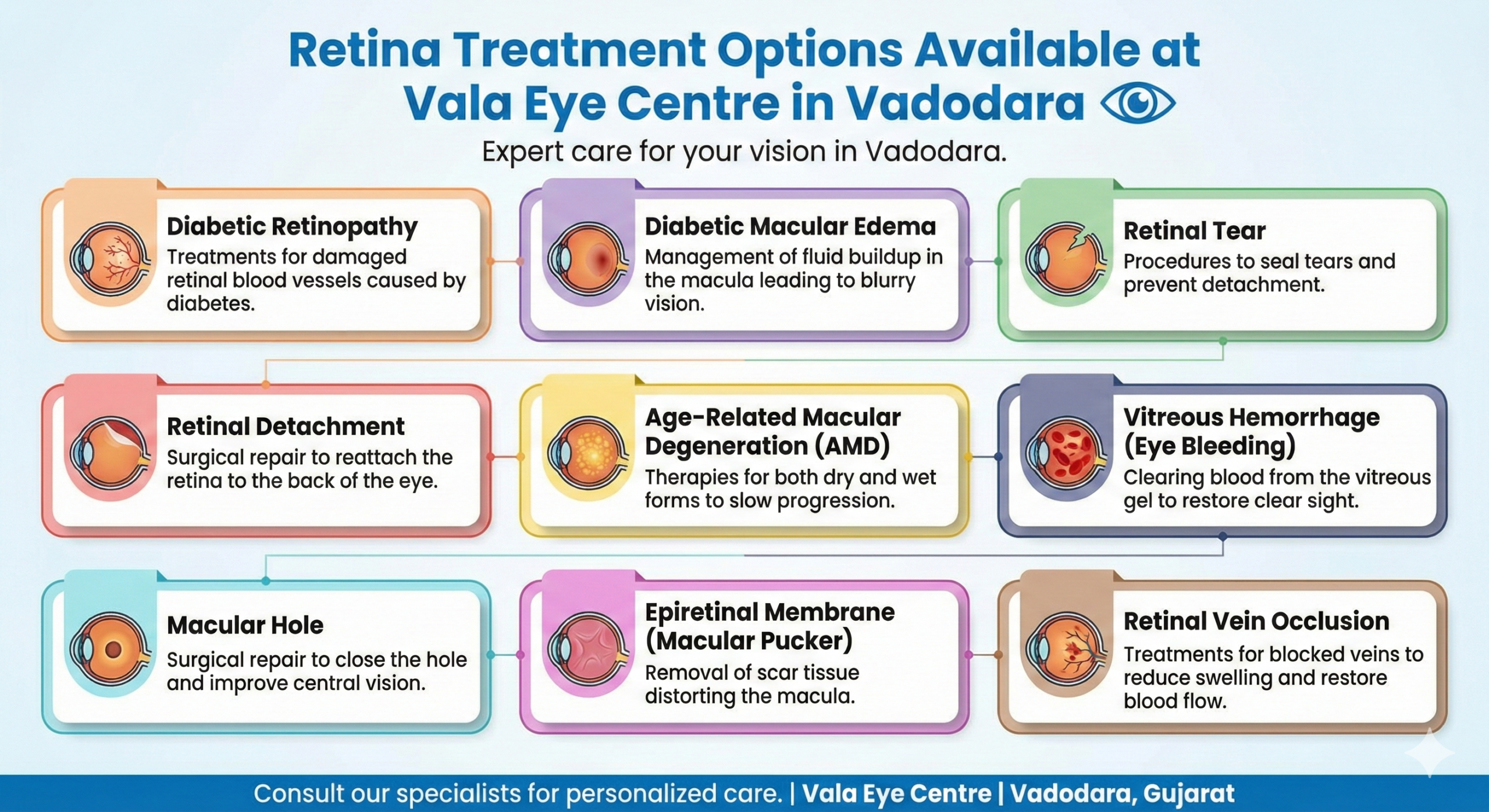
Retina specialists commonly treat conditions such as:
- diabetic retinopathy
- diabetic macular edema
- retinal tear
- retinal detachment
- age-related macular degeneration (AMD)
- vitreous hemorrhage (eye bleeding)
- macular hole
- epiretinal membrane (macular pucker)
- retinal vein occlusion
Each condition requires a specific treatment approach, depending on severity and stage.
Retina Treatment Options Available in Vadodara
- Observation and Regular Monitoring
Not all retinal conditions need immediate treatment. Mild or early-stage problems—such as:
- early diabetic retinopathy
- small, stable retinal changes
- resolving central serous retinopathy can be managed with regular follow-ups and imaging.
Monitoring ensures that treatment is started at the right time, not too early or too late.
- Medical Management and Lifestyle Control
For some patients, retina treatment also involves controlling underlying conditions such as:
Diabetes, high blood pressure, cholesterol. Proper control can slow disease progression and improve treatment outcomes.
Patients may be advised on:
- blood sugar management
- diet and lifestyle changes
- avoiding smoking
- stress reduction
- Anti-VEGF Injections (Retina Injections)
Anti-VEGF injections are one of the most common and effective retina treatments today.
Used for:
- diabetic macular edema
- wet age-related macular degeneration
- retinal vein occlusion
- macular swelling
Early treatment with injections can significantly improve or stabilize vision.
- Laser Treatment for Retina
Laser treatment is used to seal, shrink, or stabilize abnormal retinal areas.
Common indications:
- retinal tear
- diabetic retinopathy
- leaking blood vessels
- preventing retinal detachment
Types of retinal laser:
- focal laser
- pan-retinal photocoagulation (PRP)
Laser treatment helps prevent disease progression and vision loss.
Patients usually experience: bright flashes of light and mild discomfort (not pain).
Laser is often done as an outpatient procedure.
- Treatment for Retinal Tear
A retinal tear is a medical urgency. If detected early, it can usually be treated with:
laser photocoagulation and cryotherapy (freezing treatment).
These treatments create a barrier around the tear, preventing fluid from entering and causing retinal detachment.
Early treatment often avoids the need for major surgery.
- Retinal Detachment Surgery
If the retina detaches, surgery is required.
Surgical options include:
- Vitrectomy – removal of vitreous gel and repair of retina
- Scleral buckle – external support to reattach retina
- Gas or silicone oil injection – to hold retina in place during healing
The choice depends on:
- type of detachment
- location of tear
- duration of detachment
Early surgery offers the best chance of vision recovery.
- Vitrectomy Surgery
Vitrectomy is a specialized retina surgery used for:
- vitreous hemorrhage
- retinal detachment
- macular hole
- epiretinal membrane
- severe diabetic eye disease
During vitrectomy:
- the vitreous gel is removed
- retina is treated or repaired
- gel may be replaced with gas or silicone oil
Recovery depends on the condition treated, but vitrectomy often plays a vision-saving role.
- Macular Hole and Epiretinal Membrane Treatment
Macular hole – Usually treated with vitrectomy surgery. Early treatment improves visual recovery.
Epiretinal membrane (macular pucker) – Mild cases may be observed. Surgery is recommended if vision distortion worsens.
- Management of Vitreous Hemorrhage
Vitreous hemorrhage (bleeding inside the eye) may be managed by:
- observation (if mild)
- treating the underlying cause
- vitrectomy surgery (if bleeding persists)
The cause of bleeding must be addressed.
Choosing the Right Retina Treatment
The best retina treatment depends on:
- exact diagnosis
- disease stage
- vision status
- overall eye health
There is no “one-size-fits-all” approach. Personalized treatment planning is essential.
Why Early Retina Treatment Matters?
Delaying retina treatment can lead to:
- permanent vision loss
- progression to advanced disease
- more complex surgery
- longer recovery time
Many retinal conditions are painless, which is why routine eye check-ups are important—especially for diabetics and older adults.
When Should You See a Retina Specialist?
Seek retina evaluation if you notice:
- sudden floaters or flashes
- wavy or distorted vision
- curtain/shadow in vision
- sudden vision loss
- eye bleeding
- vision changes in diabetes
Final Thoughts
Advances in retinal care mean that many vision-threatening conditions can now be managed effectively if detected early. Understanding the retina treatment options available at Vala Eye Centre, Vadodara empowers patients to seek timely care and make informed decisions.
We are committed to protecting your vision through early diagnosis, advanced retinal treatments, and compassionate care. Our team guides you at every step—from evaluation to recovery—so you feel informed and supported.
If you’re experiencing any vision changes or have been advised retina treatment, don’t delay.
Book your appointment today.