
In today’s digital age, we often find children glued to screens, whether it’s for online classes, video games, or scrolling through social media. As parents, we worry about the impact of this “digital life” on their posture, their sleep, and most importantly, their eyes. You have likely noticed the trend: more and more children in Vadodara are wearing glasses at younger ages. The numbers on their prescriptions seem to climb higher every year. This condition is called Myopia (nearsightedness), and it is becoming a global epidemic.
While we often blame phones and tablets, recent medical research points to another culprit, something much simpler than blue light or pixels. The problem might not just be what our children are looking at, but where they are staying. The missing ingredient in your child’s eye health might just be Sunlight. In this comprehensive guide, we will explore the science behind why outdoor play is the most powerful “natural medicine” for your child’s eyes, how it works, and how you can implement the “Sunlight Prescription” in your busy daily routine.
The Myopia Epidemic: What is Happening to Children’s Eyes?
Before we discuss the cure, we must understand the condition. Myopia, or nearsightedness, is a refractive error where distant objects appear blurry, while close objects look clear. In the past, this was often genetic—if parents wore glasses, the children likely would too. But today, the rates of Myopia are skyrocketing far beyond what genetics can explain.
The “Long” Eye Problem
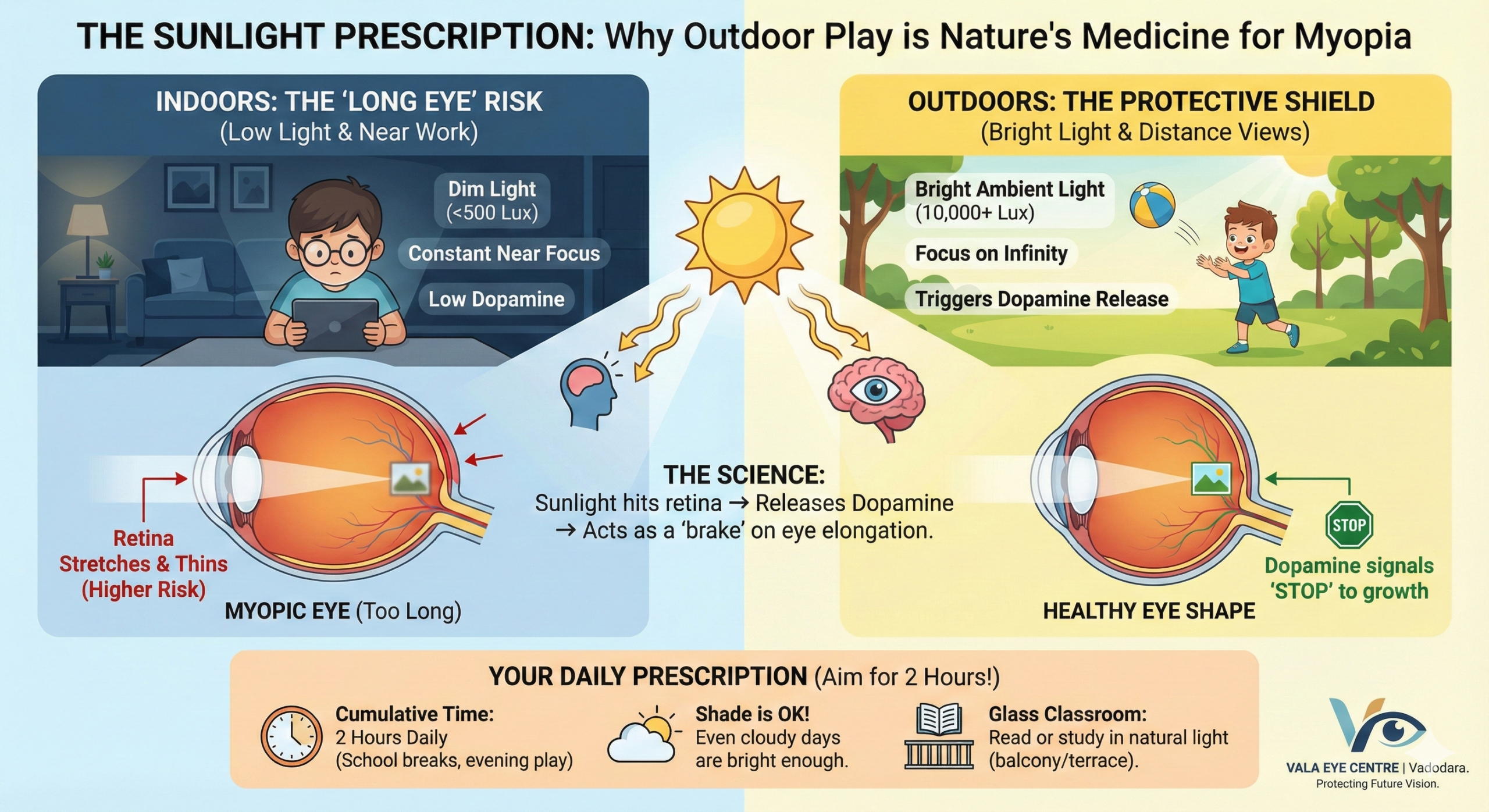
To understand why Myopia gets worse, we need to look at the anatomy of the eye. A normal human eye is shaped like a perfect sphere, like a marble. In this shape, light enters the eye and focuses perfectly on the retina (the light-sensitive layer at the back of the eye). In a child with progressive Myopia, the eyeball grows too long from front to back. It becomes shaped more like an olive or an egg than a marble.
-
The Mismatch: Because the eye is too long, the light focuses in front of the retina instead of on it.
-
The Result: Distant images are blurry.
-
The Risk: This isn’t just about thicker glasses. A physically “stretched” eye has a thinner retina. This increases the lifelong risk of serious conditions like Retinal Detachment, Myopic Maculopathy, and Glaucoma.
As a specialized Retina and Eye Care Clinic, our concern at Vala Eye Centre isn’t just correcting vision for today; it is preserving the structural health of your child’s eye for the next 60 years.
The Science of Sunlight – How the Outdoors Protects the Eye
For years, doctors told children, “Don’t sit too close to the TV.” While near-work strain is a factor, ground-breaking research from around the world (including studies in Singapore, Australia, and the US) has found a stronger correlation: Children who spend more time outdoors have lower rates of Myopia. But why? What does the sun do that a bright LED bulb cannot?
1. The Dopamine Connection
The most widely accepted scientific theory involves a neurotransmitter called Dopamine.
-
When sunlight hits the retina, it triggers the release of Dopamine.
-
Dopamine acts as a “stop signal” for eye growth. It tells the eyeball to maintain its shape and prevents it from elongating (growing too long).
-
The Indoor Problem: Indoor lighting is generally too dim to trigger this dopamine release effectively. Without regular “doses” of sunlight, the eye’s growth mechanism can become unregulated, leading to the elongation that causes Myopia.
2. The Brightness Scale (Lux)
The human eye is incredibly adaptive, so we often don’t realize the massive difference in light intensity between indoors and outdoors. Light intensity is measured in Lux.
-
Typical Living Room: 300 to 500 Lux.
-
Bright Classroom/Office: 500 to 1,000 Lux.
-
Outdoor Shade (Cloudy Day): 10,000 to 20,000 Lux.
-
Direct Sunlight (Sunny Day): 100,000+ Lux.
Even on a cloudy day, the light outside is 10 to 20 times brighter than the brightest room in your house. It is this high-intensity light that is required to stimulate the retinal dopamine cycle. You simply cannot replicate this indoors.
3. The “Focusing” Factor
When a child is outdoors, they are rarely looking at something 10 inches from their face. They are looking at cricket balls flying through the air, birds in trees, or friends running across a park.
-
This forces the eye muscles to relax and focus on infinity (distance).
-
In contrast, indoor time is almost exclusively “near work” (books, screens, toys), which keeps the focusing muscles locked in a state of tension.
The Prescription – How Much Exposure Time is Enough?
So, is 10 minutes of walking to the school bus enough? Probably not.
Current research suggests a specific “dosage” for effective Myopia prevention.
The 2-Hour Rule
The consensus among eye health experts is that children need approximately 2 hours of outdoor time per day to significantly lower the risk of developing Myopia or to slow its progression.
This can be cumulative. It doesn’t have to be two continuous hours.
-
30 minutes of recess at school.
-
30 minutes walking to/from school or tuition.
-
1 hour of play in the evening.
Does It Have to Be “Sunny”?
This is a common question, especially during the monsoon season in Vadodara. The answer is No. The sun does not have to be blazing hot. As mentioned in the Lux scale above, even a cloudy afternoon or sitting in the shade provides significantly more light than being indoors. The goal is ambient brightness, not direct UV exposure.
Managing the “Indian Parent” Dilemma – Academics vs. Play
We understand the cultural context. In India, academic pressure is high. Parents often worry that sending a child outside for two hours means two hours of “lost study time.” However, we need to reframe this mindset. Vision is a critical tool for learning. If a child’s vision deteriorates rapidly, it can affect their ability to study comfortably in the long run.
Here is how you can balance it:
-
The “Glass Classroom”: If your child must read or study, can they do it on a balcony, a terrace, or in the garden? Reading in natural light is far better for the eyes than reading under a tubelight. This counts towards their outdoor light exposure!
-
Productive Breaks: Instead of a 15-minute break watching TV or checking a phone, encourage a 15-minute walk outside.
-
Weekend Banking: If weekdays are packed with school and coaching, try to “bank” extra outdoor hours on Saturdays and Sundays. Plan family outings, picnics, or sports activities that keep everyone outside for 3-4 hours.
Safety First – Protecting the Eye While Seeking Sun
While we are prescribing sunlight, we must also be responsible. The sun emits UV rays which, in excess, can be harmful to the skin and the surface of the eye.
How to balance Myopia Prevention with UV Protection:
-
Timing Matters: The best time for outdoor play is often early morning (before 10 AM) or late afternoon (after 4 PM). The light intensity is still high enough to help the retina, but the harsh UV index is lower.
-
Hats and Caps: Encourage your child to wear a cap with a brim. This shades the eyes from direct glare while still allowing plenty of ambient light to reach the eye from the sides.
-
Sunglasses: Good quality UV-blocking sunglasses are excellent for protecting the eye’s surface. Some parents ask, “Will sunglasses block the Myopia benefit?” Generally, no—because the ambient brightness is still very high. However, letting them play without sunglasses during “safe sun” hours (early morning/late evening) is perfectly fine.
When Sunlight Isn’t Enough – Clinical Interventions
While outdoor play is the best preventative medicine, what if your child already has a high number? What if their number is jumping by -1.00 or -1.50 every year despite playing outside?
At Vala Eye Centre, we treat Myopia as a condition to be managed, not just corrected. If lifestyle changes aren’t stopping the progression, we have medical options:
1. Pharmacological Drops (Low-Dose Atropine)
Special eye drops, administered nightly, can help keep the eye from elongating. These are different from the strong drops used for eye exams. They are safe, low-dose, and highly effective for many children.
2. Myopia Control Spectacles
New technology in eyeglass lenses is now available. These aren’t standard lenses. They have specialized “defocus” zones that trick the eye into stopping its growth.
3. Routine Monitoring
The most dangerous thing you can do is wait two years between eye exams. Children with progressive myopia need checks every 6 months to measure the axial length (length of the eyeball) and the retina’s health.
Conclusion: A Bright Future Starts Outside
The battle against increasing glasses numbers is won through consistency. It is about small daily choices from choosing the park over the PlayStation, the balcony over the bedroom, and natural light over LEDs.
The “Sunlight Prescription” is free, it has zero side effects, and it comes with the bonus of Vitamin D and better physical fitness.
Key Takeaways for Parents:
-
Aim for 2 hours of outdoor time daily.
-
Shade is okay; it doesn’t have to be direct sun.
-
Distance matters: Encourage sports that involve looking far away.
-
Monitor closely: Regular eye exams are non-negotiable.
Is Your Child’s Vision Changing?
If you are concerned about how fast your child’s prescription is changing, or if you want to ensure their retina is healthy despite high myopia, we are here to help.
At Vala Eye Centre, Dr. Ruchi Vala and her team specialize in comprehensive eye care that looks beyond the glasses number. Let’s work together to protect your child’s vision for a lifetime.
Schedule your Pediatric Eye Screening today.
Disclaimer: This blog is for educational purposes only and does not constitute medical advice. Please consult an ophthalmologist for a personalized diagnosis.