
Imagine a thief entering your home. They don’t break a window or kick down the door. Instead, they sneak in silently, taking one valuable item at a time. You don’t even notice anything is missing until you look around one day and realize your house is half empty.
This is exactly how Glaucoma acts in your eyes.
Often called the “Silent Thief of Sight,” Glaucoma is one of the leading causes of blindness worldwide. But the scariest part? It usually has zero early symptoms. There is no pain, no redness, and no blurry vision—until it is too late.
At Vala Eye Centre, we believe that understanding this condition is the first step to defeating it. Here is why those routine “pressure checks” we do are the most important part of your eye exam.
What is Glaucoma? (The “Balloon” Analogy)
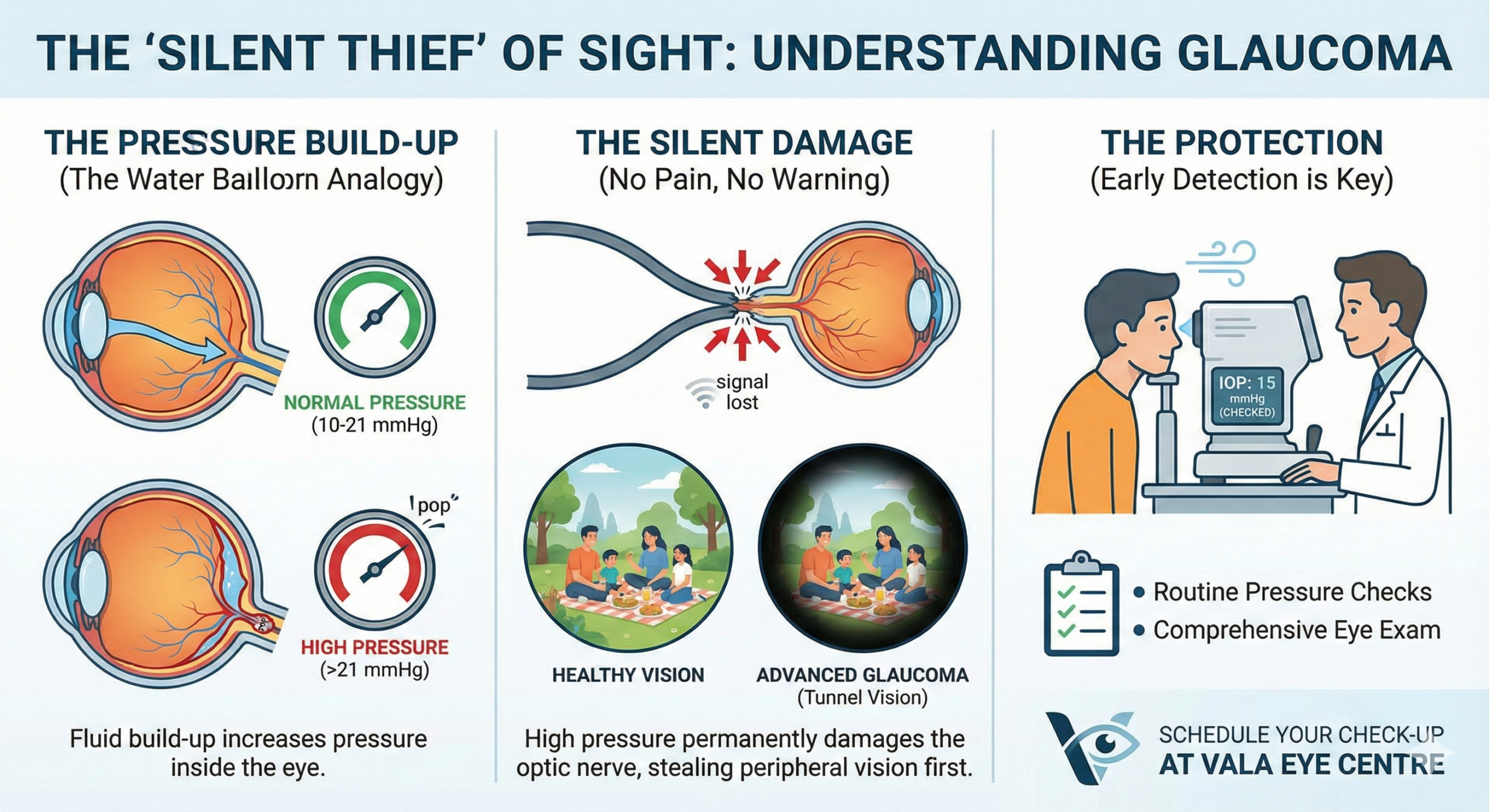
To understand Glaucoma, think of your eye like a water balloon.
Your eye constantly produces a fluid called aqueous humor to keep itself healthy and plump. In a normal eye, this fluid drains out as fast as it is made, keeping the pressure inside stable.
However, if the drainage drain gets clogged, the fluid builds up. Just like a water balloon that is overfilled, the pressure inside the eye rises. This high pressure pushes against the back of your eye, damaging the Optic Nerve—the crucial cable that sends images from your eye to your brain.
Once the optic nerve is damaged, the vision lost cannot be recovered.
Why You Won’t Feel It
Unlike a stomach ache or a toothache, high eye pressure (Intraocular Pressure or IOP) rarely hurts.
-
It starts with your side vision: Glaucoma eats away at your peripheral (side) vision first. Because your central vision (what you use to read, drive, or see faces) remains perfect, your brain “fills in the gaps,” tricking you into thinking your eyesight is fine.
-
Tunnel Vision: Over time, the “thief” takes more. Eventually, you may be left with “tunnel vision,” where you can only see what is directly in front of you.
Are You at Risk?
Anyone can get Glaucoma, but you should be extra vigilant if you fall into these categories:
-
Age: You are over the age of 40.
-
Family History: Does your parent or grandparent have Glaucoma? This significantly increases your risk.
-
Medical Conditions: You have diabetes, high blood pressure, or heart disease.
-
Medications: You have used steroid medications (inhalers, tablets, or drops) for a long time.
-
Glasses Prescription: You have high minus power (myopia) or high plus power (hyperopia).
The Good News: It IS Preventable
While Glaucoma cannot be cured (we cannot fix the nerve once it’s dead), it can be managed. If we catch it early, we can stop the thief in its tracks.
This is why the Non-Contact Tonometry (NCT) test—often called the “air puff” test—is so vital. It measures your eye pressure in seconds without touching your eye.
-
Normal Pressure: Usually between 10–21 mmHg.
-
High Pressure: Above 21 mmHg (requires further investigation).
Note: Some people can have Glaucoma even with “normal” pressure, which is why a comprehensive exam at a specialized clinic like Vala Eye Centre is better than a simple vision check at an optical shop.
How We Treat It
If diagnosed early, treatment is often simple:
-
Eye Drops: Daily drops to lower eye pressure.
-
Laser Therapy: A quick, painless beam of light to help the eye drain fluid better.
-
Surgery: For advanced cases, to create a new drainage channel.
Don’t Wait Until You Notice a Problem
You cannot rely on your vision to tell you if you have Glaucoma. By the time you notice vision loss, the silent thief has already done permanent damage.
Protect your sight. Schedule your comprehensive eye pressure check at Vala Eye Centre today.