
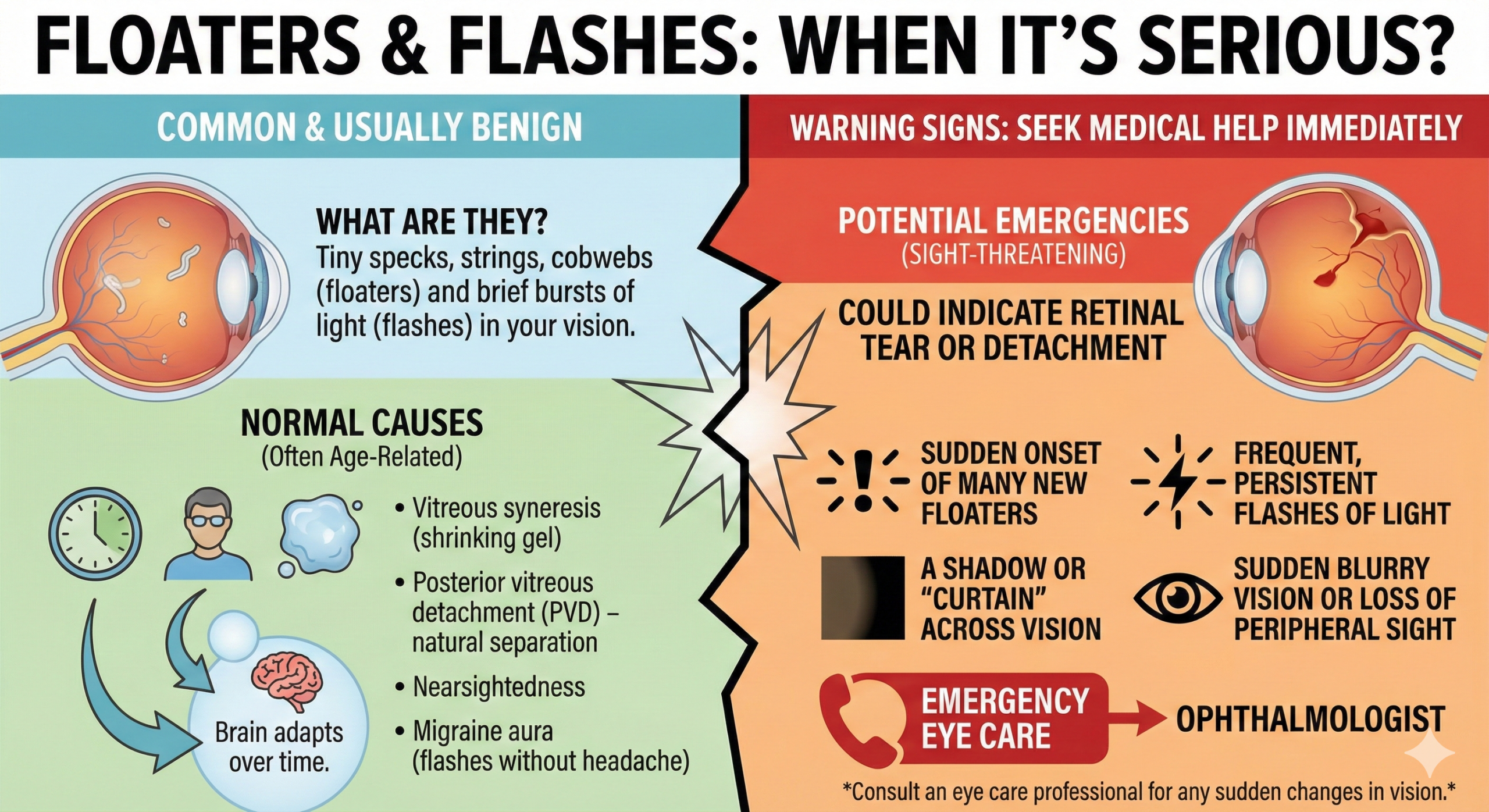
Seeing sudden black spots, cobweb-like strands, or flashes of light in your vision can be scary. Many people brush it off as “eye strain” or assume it will go away on its own. But in some cases, floaters and flashes can be an early warning sign of a retinal tear, a condition that needs urgent medical attention. While floaters are often harmless, the key is knowing when it’s serious and when you should immediately consult a retina specialist. A retinal tear can progress to retinal detachment, which may lead to permanent vision loss if not treated quickly. In this blog, we’ll explain what floaters and flashes mean, what retinal tear warning signs to watch for, and what to do next.
What Are Eye Floaters?
Floaters are small shapes that drift across your vision. They may look like:
● Black dots
● Thread-like lines
● Cobwebs
● Tiny moving shadows
Floaters are usually more noticeable when looking at a bright background like: a white wall, the sky, or a phone screen.
Floaters happen when the gel inside the eye (vitreous) changes with age and forms tiny clumps that cast shadows on the retina.
What Are Flashes in the Eye?
Flashes often look like:
● Lightning streaks
● Camera flash-like flickers
● Sudden light in the corner of vision
Flashes happen when the vitreous gel pulls or tugs on the retina, creating a sensation of light. Sometimes flashes are harmless, but if they are sudden and frequent, they may indicate the retina is being pulled strongly, raising the risk of a tear.
Are Floaters and Flashes Always Dangerous?
Not always. Many people develop a few floaters as they age, and they may not need treatment. However, sudden onset of floaters and flashes, especially when they appear together should never be ignored.
The seriousness depends on:
● How sudden the symptoms are
● Whether the number of floaters increases quickly
● Whether there is vision loss
● Whether there are additional warning signs like a “curtain” effect
Why Floaters and Flashes Can Be a Sign of Retinal Tear
A retinal tear often happens due to posterior vitreous detachment (PVD), where the vitreous gel separates from the retina as part of aging.
Most PVD cases are harmless. But sometimes, the vitreous pulls too hard and creates a small tear in the retina. Once a tear occurs, fluid can enter behind the retina and cause retinal detachment.
A retinal tear is treatable if detected early. Retinal detachment is more serious and may require surgery.
Retinal Tear Warning Signs: When Floaters and Flashes Are Serious
Here are the key signs that you should treat as urgent:
1. Sudden increase in floaters
If you suddenly notice many new floaters (especially within hours or a day), it can be a red flag.
People often describe it as:
● “a shower of black dots”
● “a swarm of insects”
● “smoke or cobwebs suddenly appearing”
This may indicate bleeding inside the eye (vitreous hemorrhage) from a retinal tear.
2. Frequent flashes, especially in the side vision
Occasional flashes can happen, but repeated flashes, especially in dim light or at night may mean the retina is being tugged.
If flashes are persistent or worsening, consult a retina doctor urgently.
3. A shadow, curtain, or dark patch in your vision
This is one of the most important warning signs.
If you notice:
● A dark curtain coming from one side
● A shadow spreading across vision
● Missing areas in vision
It may indicate retinal detachment, which is a medical emergency.
4. Sudden blurred vision or reduced sharpness
A retinal tear or bleeding can cause vision to suddenly become blurry, hazy, or unclear.
If your vision changes suddenly along with floaters/flashes, don’t wait.
5. Floaters with eye bleeding symptoms
Some patients experience:
● A sudden cloud or haze
● Red tint in vision
● Significant blur
This may be due to vitreous hemorrhage, which can happen when a tear causes bleeding.
Who Is at Higher Risk for Retinal Tear or Detachment?
Floaters and flashes can happen to anyone, but you may be at higher risk if you have:
● High myopia (high power glasses)
● History of eye trauma or injury
● Previous cataract surgery
● Family history of retinal detachment
● Diabetes-related retinal problems
● Previous retinal tear in the other eye
● Age above 40–50
If you fall into a high-risk group, even mild symptoms should be checked.
What Should You Do If You Notice Floaters and Flashes?
Here’s what you should do immediately:
1. Don’t ignore sudden symptoms
2. Avoid heavy exercise until checked
3. Get a dilated retina examination
A proper retina evaluation includes:
● pupil dilation
● retina examination using special lenses
● sometimes OCT or retinal imaging
Only a detailed retina exam can confirm whether there is a tear.
Visit a retina specialist urgently. The earlier a retinal tear is detected, the easier it is to treat.
How Is a Retinal Tear Treated?
If a retinal tear is found early, treatment is often quick and effective.
1. Laser treatment (retinal laser / photocoagulation)
Laser is used to create a seal around the tear, preventing fluid from entering behind the retina.
Most patients feel:
● mild discomfort
● bright flashes
● slight pricking sensation
Laser is usually done as an outpatient procedure.
2. Cryotherapy (freezing treatment)
In some cases, freezing treatment may be used instead of laser depending on the tear’s location.
If retinal detachment occurs
If the retina detaches, surgery may be needed, such as:
● vitrectomy
● scleral buckle
● gas injection
That’s why early detection is so important.
Can Floaters Go Away on Their Own?
Some floaters become less noticeable over time because: the brain adapts or floaters settle downward
But new floaters should still be checked, especially if they come with flashes.
Important: even if symptoms reduce, a tear can still be present.
Don’t Ignore Sudden Floaters and Flashes
Floaters and flashes are common, but when they appear suddenly or worsen quickly, they can be a warning sign of a retinal tear. The good news is that early treatment can prevent retinal detachment and protect your vision.
If you notice:
● sudden increase in floaters
● frequent flashes
● curtain/shadow in vision
● sudden blur
Consult a retina specialist here in Vadodara itself without delay. At Vala Eye Centre, your vision is our priority. Our team of experts will diagnose and guide you towards right treatment prompty.
Visit today.