
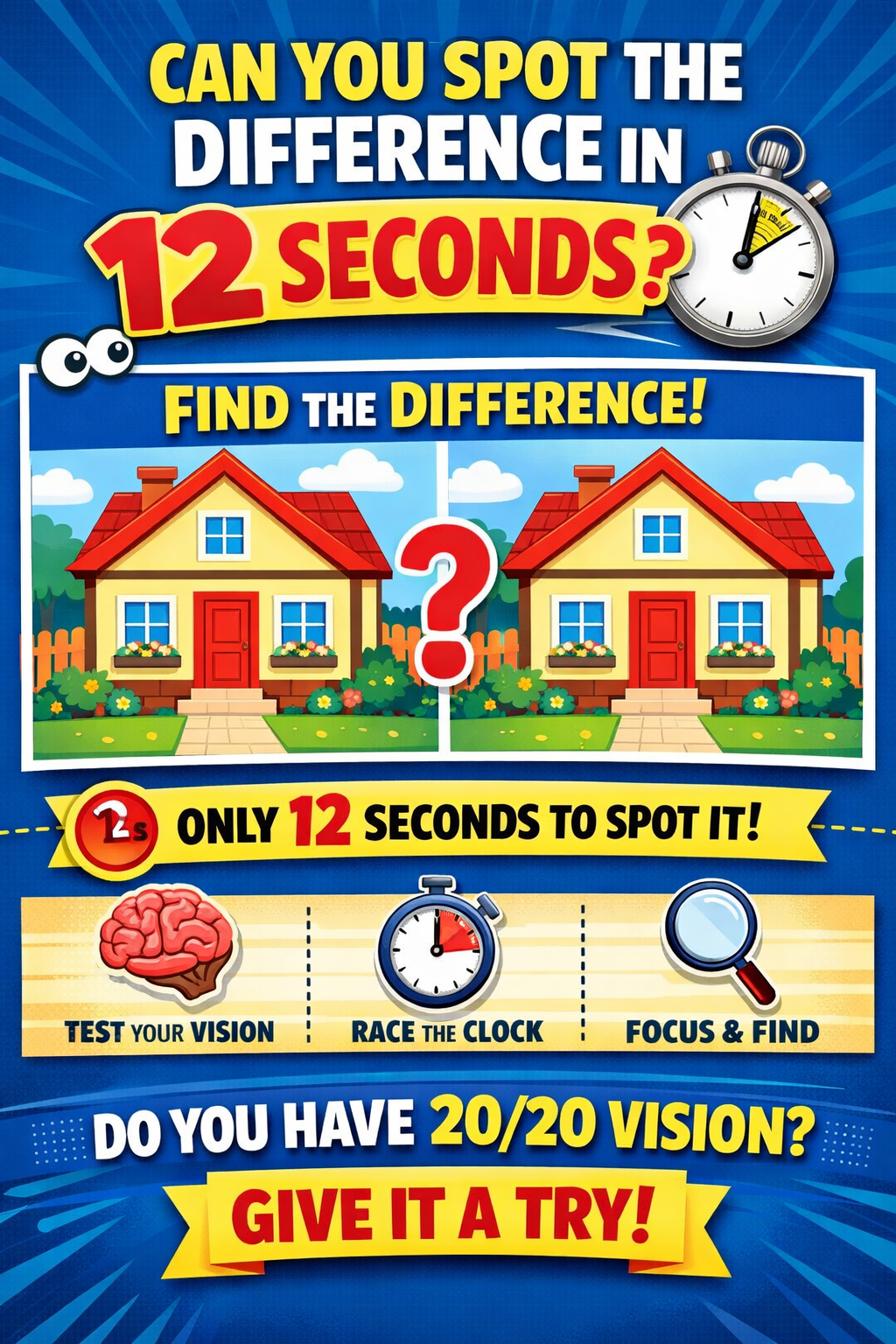
Are you confident about your eyesight? Think you have sharp visual skills? Here’s a fun challenge that’s taking social media by storm — and it’s all about how well you can spot tiny differences under pressure. Let’s dive in!
The Brain + Eye Connection
Before we get to the challenge itself, it’s fascinating to understand why tests like this are so tricky. Our brains are wired to recognize patterns quickly. When we see something familiar like a group of similar images or letters our mind automatically fills in details without analyzing every single element. This helps us read faster and notice common shapes instantly, but it can also make us overlook tiny anomalies.
That’s where visual challenges come in. They exploit this pattern recognition system, forcing your brain to slow down and really look and not just glance. And that makes these puzzles not just fun, but great workouts for your attention and focus!
The 12-Second Vision Challenge
Here’s how the challenge works:
-
You’re shown two nearly identical images.
-
Your task is to find the one subtle difference between them.
-
You only have 12 seconds to spot it!
It sounds simple… until you try it. Many people struggle because the difference is hidden in plain sight. Whether it’s a slightly altered window on a house, a small letter change, or a tiny missing element, your brain might automatically say “yeah, they look the same,” before you notice the detail that makes them different.
Why These Tests Are Tough
Here’s what makes these challenges so tricky for most of us:
-
Pattern recognition shortcuts: Your brain often scans for the overall picture rather than little details.
-
Limited time pressure: The clock adds a bit of stress, which makes your brain favor speed over accuracy.
-
Distractions in the image: Other shapes, colors, or objects can pull your focus away.
-
Expectations: If you think both images are same, your brain keeps assuming they are — until you consciously slow down.
Even people with excellent visual acuity which is often referred to as 20/20 vision in eye exams and can miss the difference if they rush or get distracted.
What Does “20/20 Vision” Really Mean?
A lot of people think 20/20 vision means perfect eyesight but it simply refers to how well you can see details at a certain distance compared to the average person. In medical terms, 20/20 is considered normal visual acuity. It doesn’t measure everything about your sight, like depth perception or color vision just clarity at a distance. So even if you have 20/20 vision, that doesn’t automatically mean you will ace every visual puzzle online. These tests are about focus, perception, and attention to detail all brain skills as much as eye skills!
Did You Spot It?
If you found the subtle difference in under 12 seconds — congratulations! 🎉 That likely means your attention to detail and quick perception are strong. But if you didn’t, don’t worry. These optical challenges are supposed to be tricky. Many people only see the hidden change after a few attempts!
Want another challenge? Try similar optical puzzles — like finding the odd letter in a sea of others or spotting a flipped number in a grid. With practice, your observation skills can improve — and your brain gets a fun exercise too!